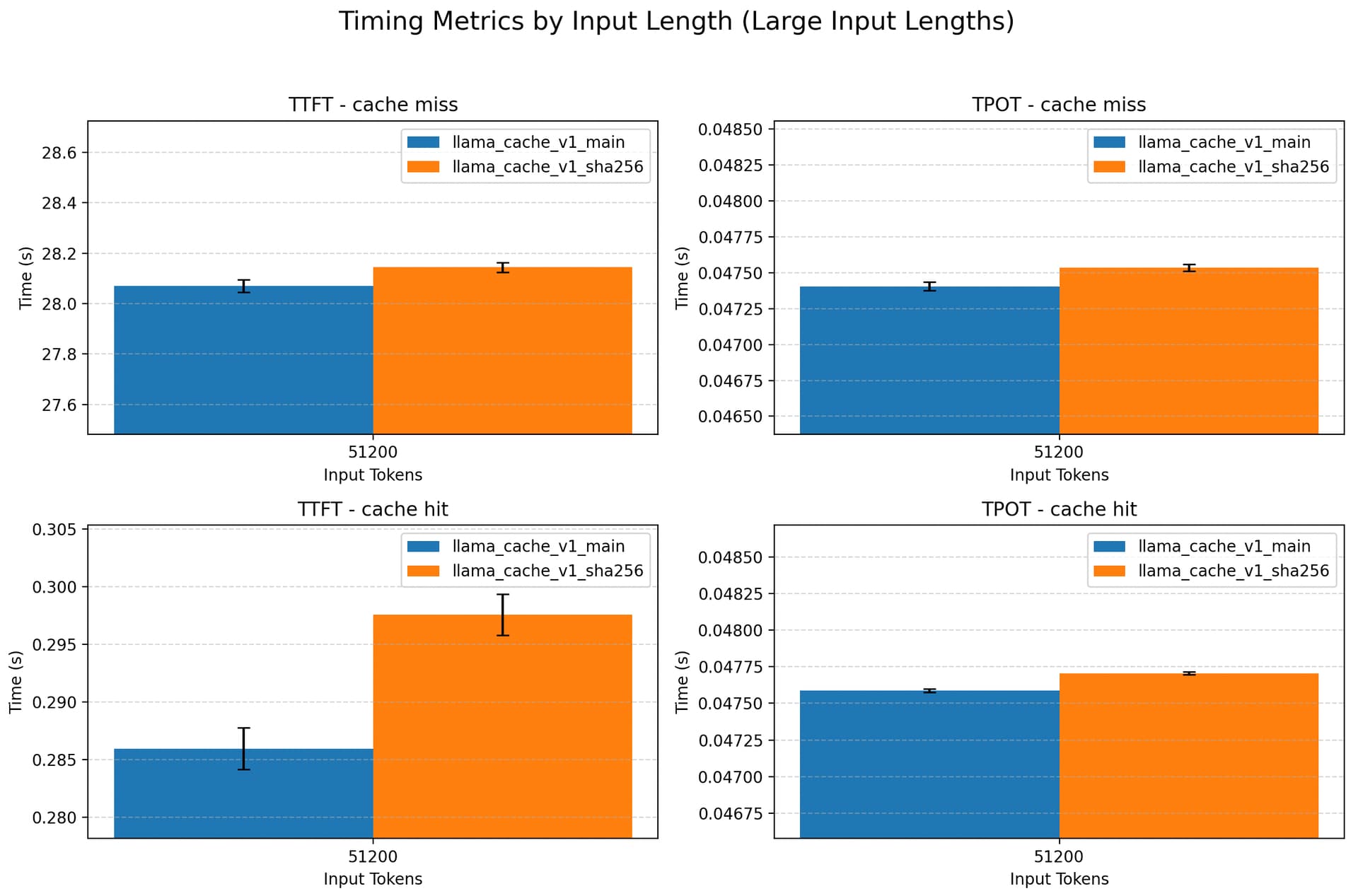
Also attaching the code I used (results in PR), which hashes the same data types as in vLLM.
Also added blake2b
import hashlib
import math
import pickle
import random
import time
from typing import List, Optional
import blake3

import hashlib
import pickle
import json
import marshal

def sha256_pickle(input) -> int:
    input_bytes = pickle.dumps(input, protocol=pickle.HIGHEST_PROTOCOL)
    return int.from_bytes(hashlib.sha256(input_bytes).digest(), byteorder="big")

def sha256_json(input) -> int:
    input_str = json.dumps(input, sort_keys=True)
    input_bytes = input_str.encode("utf-8")
    return int.from_bytes(hashlib.sha256(input_bytes).digest(), byteorder="big")

def sha256_str(input) -> int:
    input_bytes = str(input).encode("utf-8")
    return int.from_bytes(hashlib.sha256(input_bytes).digest(), byteorder="big")

def sha256_repr(input) -> int:
    input_bytes = repr(input).encode("utf-8")
    return int.from_bytes(hashlib.sha256(input_bytes).digest(), byteorder="big")

def sha256_marshal(input) -> int:
    input_bytes = marshal.dumps(input)
    return int.from_bytes(hashlib.sha256(input_bytes).digest(), byteorder="big")

def blake3_pickle(input) -> int:
    input_bytes = pickle.dumps(input, protocol=pickle.HIGHEST_PROTOCOL)
    return int.from_bytes(blake3.blake3(input_bytes).digest(), byteorder="big")

def blake2b_pickle(input) -> int:
    input_bytes = pickle.dumps(input, protocol=pickle.HIGHEST_PROTOCOL)
    return int.from_bytes(hashlib.blake2b(input_bytes).digest(), byteorder="big")

# for performance comparison only
def hash_pickle(input) -> int:
    key = pickle.dumps(input, protocol=pickle.HIGHEST_PROTOCOL)
    return hash(key)

hash_strategies = {
    "sha256_pickle": sha256_pickle,
    "sha256_json": sha256_json,
    "sha256_str": sha256_str,
    "sha256_repr": sha256_repr,
    "sha256_marshal": sha256_marshal,
    "hash": hash,
    "hash_pickle": hash_pickle,
    "blake3_pickle": blake3_pickle,
    "blake2b_pickle": blake2b_pickle,
}

_block_hash = None
_none_hash = None

def init_hash(hash_name: str):
    global _block_hash
    global _none_hash

    if hash_name in hash_strategies:
        _block_hash = hash_strategies[hash_name]
    else:
        raise ValueError(f"Unknown hash function: {hash_name}")

    none_key = tuple(int(ord(c)) for c in 'None')
    _none_hash = _block_hash(none_key)

def compute_hash(is_first_block: bool,
         prev_block_hash: Optional[int],
         cur_block_token_ids: List[int],
         extra_hash: Optional[int] = None) -> int:
    if is_first_block and prev_block_hash is None:
        prev_block_hash = _none_hash
    return _block_hash((int(is_first_block), prev_block_hash, *cur_block_token_ids,
                    int(extra_hash)))

def split_tokens(tokens: List[int], block_size: int) -> List[List[int]]:
    return [tokens[i:i + block_size] for i in range(0, len(tokens), block_size)]

def test(hash_name: str):
    init_hash(hash_name)
    random.seed(0)
    num_tokens = 50_000

    # warmup
    h = compute_hash(False, _none_hash, (1, 2, 3, 4), 123)

    t = []
    h = _none_hash
    for i in range(50):
        token_ids = [random.randint(0, 100_000) for _ in range(num_tokens)]
        chain = split_tokens(token_ids, 16)
        is_first_block = i == 0

        t0 = time.time()
        for chain_block in chain:
            h = compute_hash(is_first_block, h, chain_block, 123)
            assert h is not None

        t.append((time.time() - t0) * 1000*1000)

    t_mean = sum(t) / len(t)
    t_std = math.sqrt(sum((t - t_mean)**2 for t in t) / len(t))
    t_mean_error = t_std / math.sqrt(len(t))

    print(f"{hash_name}, {len(chain)} blocks")
    print(f"\tmean: {t_mean / 1000:.2f}ms")
    print(f"\tstd: {t_std / 1000:.2f}ms")
    print(f"\tmean error: {t_mean_error:.2f}us")
    print(f"\tper block: {t_mean / len(chain):.3f}us")
    return t_mean/1000

functions = hash_strategies.keys()
t = {f:test(f) for f in functions}

print(f"| Method           | Time (ms) | Overhead (ms) |")
print(f"|------------------|-----------|---------------|")
print(f"| hash             | {t['hash']:9.2f} | {t['hash'] - t['hash']:12.2f}  |")
print(f"| hash+pickle      | {t['hash_pickle']:9.2f} | {t['hash_pickle'] - t['hash']:12.2f}  |")
print(f"| blake2b+pickle   | {t['blake2b_pickle']:9.2f} | {t['blake2b_pickle'] - t['hash']:12.2f}  |")
print(f"| blake3+pickle    | {t['blake3_pickle']:9.2f} | {t['blake3_pickle'] - t['hash']:12.2f}  |")
print(f"| sha256+pickle    | {t['sha256_pickle']:9.2f} | {t['sha256_pickle'] - t['hash']:12.2f}  |")
print(f"| sha256+json      | {t['sha256_json']:9.2f} | {t['sha256_json'] - t['hash']:12.2f}  |")
print(f"| sha256+str       | {t['sha256_str']:9.2f} | {t['sha256_str'] - t['hash']:12.2f}  |")
print(f"| sha256+repr      | {t['sha256_repr']:9.2f} | {t['sha256_repr'] - t['hash']:12.2f}  |")
print(f"| sha256+marshal   | {t['sha256_marshal']:9.2f} | {t['sha256_marshal'] - t['hash']:12.2f}  |")
print(f"|(sha256 vs. hash) | ({t['sha256_pickle']:8.2f})| ({t['sha256_pickle'] - t['hash_pickle']:11.2f}) |")
Apple M2
| Method |
Time (ms) |
Overhead (ms) |
| hash |
0.68 |
0.00 |
| hash+pickle |
1.94 |
1.26 |
| blake2b+pickle |
3.83 |
3.15 |
| blake3+pickle |
4.14 |
3.46 |
| sha256+pickle |
3.58 |
2.90 |
| sha256+json |
8.85 |
8.17 |
| sha256+str |
5.62 |
4.94 |
| sha256+repr |
5.64 |
4.96 |
| sha256+marshal |
4.90 |
4.21 |
| (sha256 vs. hash) |
( 3.58) |
( 1.64) |
Intel Xeon @ 2.20GHz
| Method |
Time (ms) |
Overhead (ms) |
| hash |
1.53 |
0.00 |
| hash+pickle |
4.42 |
2.89 |
| blake2b+pickle |
7.30 |
5.77 |
| blake3+pickle |
7.53 |
6.00 |
| sha256+pickle |
7.78 |
6.25 |
| sha256+json |
20.79 |
19.25 |
| sha256+str |
12.81 |
11.28 |
| sha256+repr |
12.90 |
11.37 |
| sha256+marshal |
11.12 |
9.59 |
| (sha256 vs. hash) |
( 7.78) |
( 3.36) |